
The True Cost of Rodent Anesthesia: Isoflurane, Oxygen, Calibration, and 10-Year Total Cost
A 10-year view of agent, oxygen, calibration, and downtime
TL;DR
Most anesthesia “cost” is operating cost. In this article, we summarize our newest whitepaper, including how using lower flow rates can extend the same bottle of isoflurane from 27 hours to 412 hours and a 10L oxygen tank from 22 hours to 908 hours simply by lowering the flow rate. The same example includes €300/year in annual calibration cost for a traditional vaporizer vs €0 for the low-flow system and calculates a 29× reduction in running costs at representative European pricing.
The procurement trap: buying once, paying forever
An anesthesia system shows up as a capital purchase. The station behaves like a recurring expense: agent, oxygen, scavenging consumables, calibration, and the scheduling mess created by downtime.
If your facility uses anesthesia frequently, the purchase price stops being the main variable pretty quickly. Operating cost and station consistency start to drive decisions—especially in multi-user labs and multi-site programs.
Whitepaper Summary: The low-flow numbers most labs don’t have
In a recent talk on low-flow rodent anesthesia, we walked through a simple mismatch that drives most waste anesthetic gas: traditional mouse inhalation anesthesia is often delivered at 1–1.5 L/min, while mice breathe an average tidal volume around ~26 mL/min; doubling that to create a recommended minimum delivery rate is still only ~52 mL/min. The majority of delivered anesthetic is therefore wasted into scavenging systems or the surrounding environment.
Using representative mouse anesthesia settings, we compared the same 2% isoflurane concentration delivered at 0.1L/min (100mL /min) versus 1.5 L/min (a 15× flow reduction). The key point: the intended anesthetic concentration is held constant; the flow rate is what changes the waste volume.
That shift drives measurable consumable efficiency changes—one bottle of isoflurane lasting 412 hours vs 27 hours, and a 10L oxygen tank lasting 908 hours vs 22 hours in the example. Lower flow rates also translate to lower CO₂ emissions; 0.5kg from a low flow rate compared to 7.2kg from a traditional flow rate!
The same example pricing model (region-dependent) estimates a 29× reduction in running costs under representative European pricing, and shows how savings scale with usage.
Request the full low-flow factsheet white paper
Want to know how we got those numbers? Interested in more details on return on investment, using N₂O, or staff safety? Request access to the complete white paper.
What actually drives cost in a rodent anesthesia station
1) Fresh gas flow (because it drives everything else)
Our whitepaper solidifies this point: hold the anesthetic concentration constant and change only flow. In our representative example, both systems maintain identical 2% isoflurane, and the only meaningful difference is flow: 0.1 L/min vs 1.5 L/min.
That one change affects:
- how fast you burn through isoflurane
- how fast you burn through oxygen
- how much waste gas you need to scavenge
- how much time you spend dealing with canisters and supplies
- how much variability creeps into “the way we usually do it”
2) Isoflurane consumption
This is usually the biggest line item people feel first.
In our example, when 2% isoflurane was used, a single bottle of isoflurane lasts 412 hours in the low-flow system vs 27 hours traditionally.
You don’t use the same dose of isoflurane every time, so the exact hour count won’t match every facility. The point is directional: high flow drains bottles fast, and it does it invisibly (because it feels like “normal operating procedure”).
3) Oxygen usage
Oxygen is easy to ignore because it’s a “facility supply” until it becomes an interruption.
Kent Scientific digital vaporizers help reduce oxygen consumption two ways; not only by using those lower flow rates, but also by using room air as a carrier gas (when appropriate). In the same example: a 10L oxygen tank lasts 908 hours with the low-flow system using room air supplemented with O₂ at 50% versus 22 hours for a traditional setup relying solely on compressed gas. Even holding at 100% O₂, using a low flow rate still increases the time an O₂ tank can be used: X hours!
That’s the difference between “tanks are a constant operational task” and “tanks last.”
4) Calibration and inspection overhead
This is where facilities get serious—especially internationally, and especially in regulated environments.
Our whitepaper includes a representative annual calibration cost of €300/year for a traditional vaporizer and €0/year for the low-flow electronic vaporizer.
Even if your calibration costis different, calibration also involves unpaid labor: scheduling, paperwork, interruption, and the uncomfortable fact that stations drift when they’re not maintained. Calibration exists because accuracy matters; it’s the process of comparing an instrument against a reference standard and adjusting/verifying performance.
The whitepaper also makes a point procurement teams understand immediately: even at zero active use, calibration alone makes total cost converge. In the example, €300/year calibration causes the traditional system’s total cost to converge with the higher upfront investment after ~14.3 years, even with no consumable savings.
That’s not a “buy now” argument. It’s a “don’t ignore the hidden operating costs” argument.
A simple, facility-friendly total cost model
If you’re trying to justify a station change, you don’t need perfect forecasting. You need a model that’s honest and easy to explain.
Start with:
- hours/week under anesthesia
- typical maintenance flow and percentage settings
- agent cost
- oxygen cost
- annual calibration cost
- number of stations
Then run it for 1 year and 10 years.
Our factsheet already does this using usage bands that map to real programs:
- 50 hrs/year (~1 hr/week)
- 200 hrs/year (~4 hrs/week)
- 500 hrs/year (~10 hrs/week)
Using representative European pricing assumptions in the sheet (isoflurane €65/250 ml; O₂ €270/10L tank), it calculates:
- 50 hrs/year: €23 low-flow vs €1,026 traditional (savings €1,003)
- 200 hrs/year: €91 low-flow vs €3,204 traditional (savings €3,113)
- 500 hrs/year: €227 low-flow vs €7,560 traditional (savings €7,333)
Then it states the practical takeaway: at 500 hrs/year (roughly 10 hrs/week), annual savings exceed €7,300, and facilities with multiple stations or longer procedures see proportionally greater returns.
Again: those are example numbers tied to the sheet’s assumptions. Your pricing and usage pattern will differ. But the structure holds.
The other “cost” that wrecks schedules: downtime and rework
A station can be “cheap” and still cost you:
- cancelled procedure blocks
- shifting staff time
- retraining people on inconsistent setups
- repeat work because recoveries drifted and endpoints got noisy
Our factsheet calls out “no calibration downtime” as a practical benefit. In a busy facility, that’s not a nice-to-have. It’s fewer disruptions to schedules and fewer reasons studies drift from plan.
Why this becomes a multi-site problem fast
If you run one station occasionally, you can tolerate a lot of inefficiency.
If you run:
- multiple rooms
- multiple users
- multiple sites
then “efficiency” becomes standardization: the station behaves predictably, consumables last, and the workflow is easier to document and defend.
This is one reason international programs move faster on anesthesia modernization. They need:
- consistent station behavior across sites
- fewer maintenance surprises
- lower ongoing burden per station
Operating cost is the part that scales.
A short note on environmental Impact
Even if your justification is cost, sustainability is now part of the conversation. Volatile anesthetics have measurable climate impact, and professional guidance frames low fresh gas flow as having economic and environmental benefits in general anesthesia contexts.
Your lab doesn’t need to become an environmental nonprofit. It needs to run anesthesia intentionally, because waste is part of both cost and emissions.
What to do next
Pull four numbers from your facility:
- average hours/week under anesthesia per station
- current maintenance flow rates
- agent and oxygen pricing (your actual vendor costs)
- annual calibration/maintenance cost (internal or external)
Then compare:
- consumable cost per hour
- calibration/downtime friction
- total cost at 1 year and 10 years
- how it scales across stations
If you want the “quick start” version, our factsheet’s benchmarks (50, 200, 500 hrs/year) are a good first pass.
Where Kent fits in
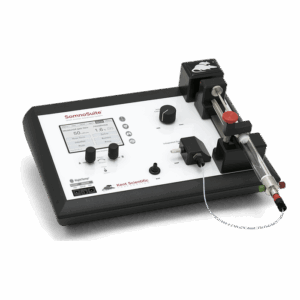
This cost model is built around low-flow anesthesia as implemented in SomnoFlo O₂ Care, using the representative settings listed (2% isoflurane; 0.1 L/min; room air supplemented with oxygen in the example).
If you share:
- species
- hours/week
- typical flow rates and anesthetic percentages
- number of stations
- your regional consumable pricing
…we can help model a facility-specific total cost picture that your finance team can actually use.
Cost of Rodent Anesthesia FAQ
What makes rodent anesthesia expensive over time?
Operating costs: agent consumption, oxygen usage, calibration/maintenance, and workflow downtime. Those costs shift dramatically when flow is reduced.
Why does low-flow reduce costs so much?
Because it reduces the volume of anesthetic and carrier gas used per unit time. In our example, a bottle of isoflurane lasts 412 hours vs 27 hours, and a 10L oxygen tank lasts 908 hours vs 22 hours.
How fast do savings show up?
In our pricing model, even at a low use of 50 hrs/year, the cost difference is recovered within approximately four years, and at 500 hrs/year annual savings exceed €7,300.
Does calibration matter even if we don’t use the station much?
Yes; to ensure consistent performance, traditional vaporizers should still be calibrated annually, even if use is low. At zero active use, the annual calibration cost alone (representative €300/year) causes total cost to converge after ~14.3 years.
Related Posts
IACUC Protocols for Rodent Research: What to Include and How to Prepare
RFID Microchips for Mice and Rats: A Guide to Rodent Identification
Laboratory Animal Management: Building Better Rodent Research Workflows
CODA vs. Other Rodent Blood Pressure Systems: How to Compare Tail-Cuff Options
Rat as a Model Organism: Advantages, Limitations, and When to Use Rats in Research
Tail-Cuff vs. Telemetry: How to Choose Based on Study Design
How to Reduce Waste Anesthetic Gas in Rodent Workflows
Guide to Green Anesthesia in Research Labs
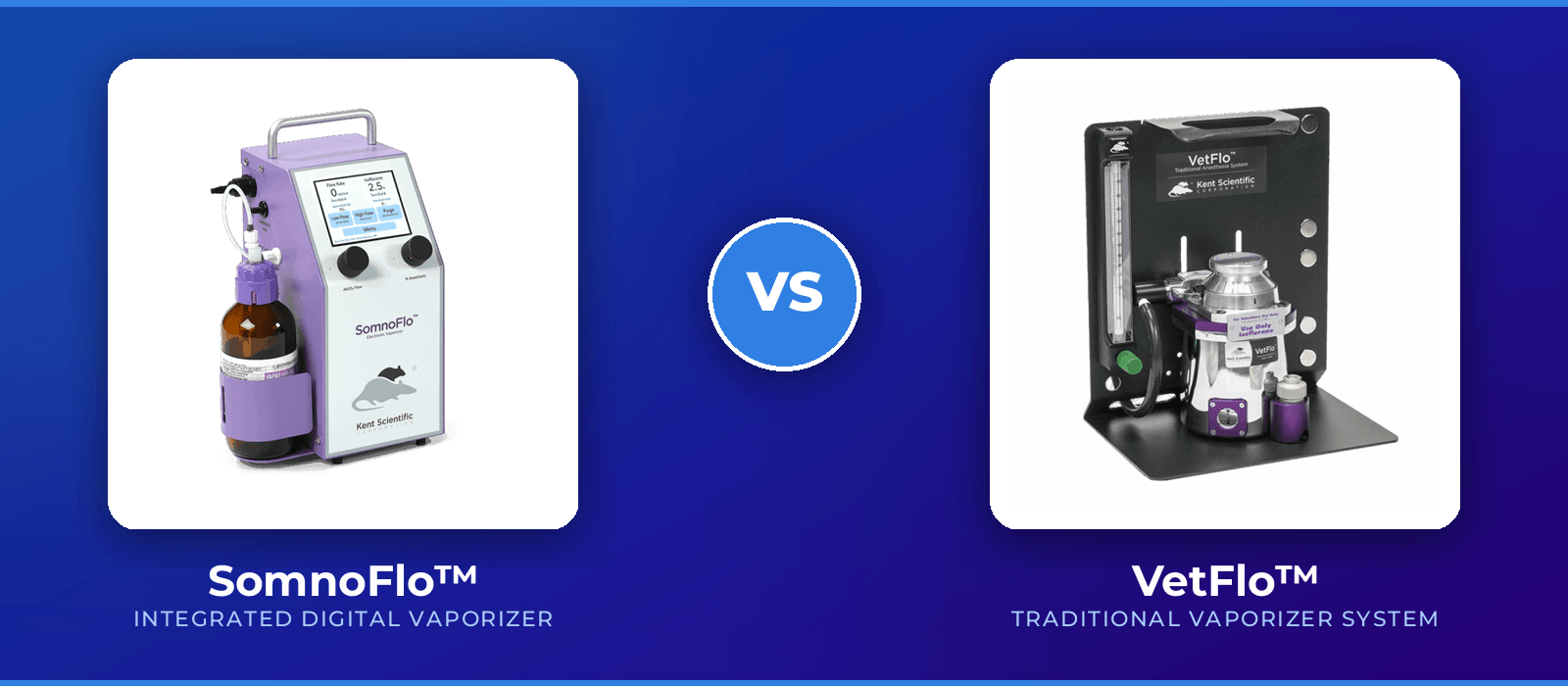
Traditional vs. Integrated Digital: How to choose Anesthetic Vaporizers
Research Workflows: What to Consider When Choosing Between Rats and Mice?
Guide to Waste Anesthesia Gas Leakage and Compliance
Building a Preclinical Procedure Station: Anesthesia, Oxygen, Monitoring, and Surgical Tools
Important Note: The content on this blog is general educational material. It is not a protocol, regulatory guidance, veterinary recommendation, clinical directive, or safety instruction for any specific laboratory, study, animal model, institution, species, procedure, or equipment configuration.
Do not apply any information from this blog to your research without first independently confirming that it is appropriate for your specific protocol, species, model, equipment configuration, firmware version, institutional requirements, IACUC or ethical review approvals, safety policies, and applicable regulations. To the extent any content on this blog addresses Kent Scientific or other specific products, it does not replace, modify, or supplement the official User Manual or product labeling for those products.
Kent Scientific assumes no liability for any outcome resulting from reliance on blog content. Every research environment is different, and the suitability of any approach described here for your specific circumstances can only be determined by qualified personnel with knowledge of your particular setup, protocol, and regulatory obligations. Always consult your institutional veterinarian, IACUC, facility leadership, safety officer, and official product documentation before implementing any change to your procedures.