CODA vs. Other Rodent Blood Pressure Systems: How to Compare Tail-Cuff Options
CODA vs. Other Rodent Blood Pressure Systems: How to Compare Tail-Cuff Options
TL;DR
The closest alternatives to the CODA® High Throughput System are the Hatteras MC4000, Visitech BP-2000, and IITC MRBP because each supports multi-animal, non-invasive tail-cuff blood pressure measurement in mice and rats. Panlab can accommodate multiple restrained animals, but its measurements are sequential rather than simultaneous. Muromachi offers specialized single-animal capability, while implantable telemetry answers a different study question by providing continuous measurements in freely moving animals. The right choice depends less on a vendor’s accuracy headline and more on the study endpoint, required throughput, detection method, animal population, and need for continuous versus scheduled measurements.
The real competitive set is smaller than it looks
Search for a rodent blood pressure monitor and you will find a long list of systems making similar promises. Put those systems into an actual study workflow, however, and the field narrows quickly.
For laboratories comparing the CODA High Throughput System, the closest alternatives are systems that can measure multiple mice or rats non-invasively using the tail-cuff method. That makes the Hatteras MC4000, Visitech BP-2000, and IITC MRBP the most direct comparisons. Panlab’s NIBP platform overlaps with the same application, but its multi-animal configuration measures animals sequentially. Muromachi’s MK-2000ST is a specialized single-animal alternative.
Telemetry belongs in the discussion, too, but not in the same column. It is an invasive method designed for continuous blood pressure measurement in conscious, freely moving animals. Tail-cuff systems are better suited to scheduled, non-invasive measurements and higher-throughput screening. In some programs, the methods are complementary rather than interchangeable.
That distinction matters. Comparing every system on channel count alone can produce an impressively tidy spreadsheet and a remarkably poor purchasing decision.
Start with the study question, not the equipment list
Before comparing instruments, define the job the system must do.
A laboratory screening several treatment groups at planned time points has different requirements from one studying circadian variation, short-lived responses, or beat-to-beat hemodynamics. Tail-cuff methods can support comparisons of average blood pressure between groups and detect larger changes when protocols are appropriately designed. They do not provide continuous measurements throughout the light-dark cycle or capture immediate responses as an implanted arterial sensor can.
In a 2023 editorial in Hypertension, Harrison and colleagues concluded that non-invasive tail-cuff measurements remain acceptable for many studies, particularly for comparing average pressure between groups or documenting larger changes. The authors also cautioned that tail-cuff measurements are more variable than radiotelemetry, do not capture diurnal fluctuation, and may not adequately quantify immediate or small changes. They specifically described tail-cuff for high-throughput work and telemetry for confirmation in smaller groups as a potentially acceptable combined strategy, depending on the experiment. Read the open-access editorial.
The practical first question is therefore not, “Which monitor is best?” It is, “What biological signal must this study resolve?”
What makes CODA® different?
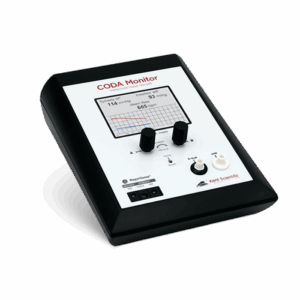
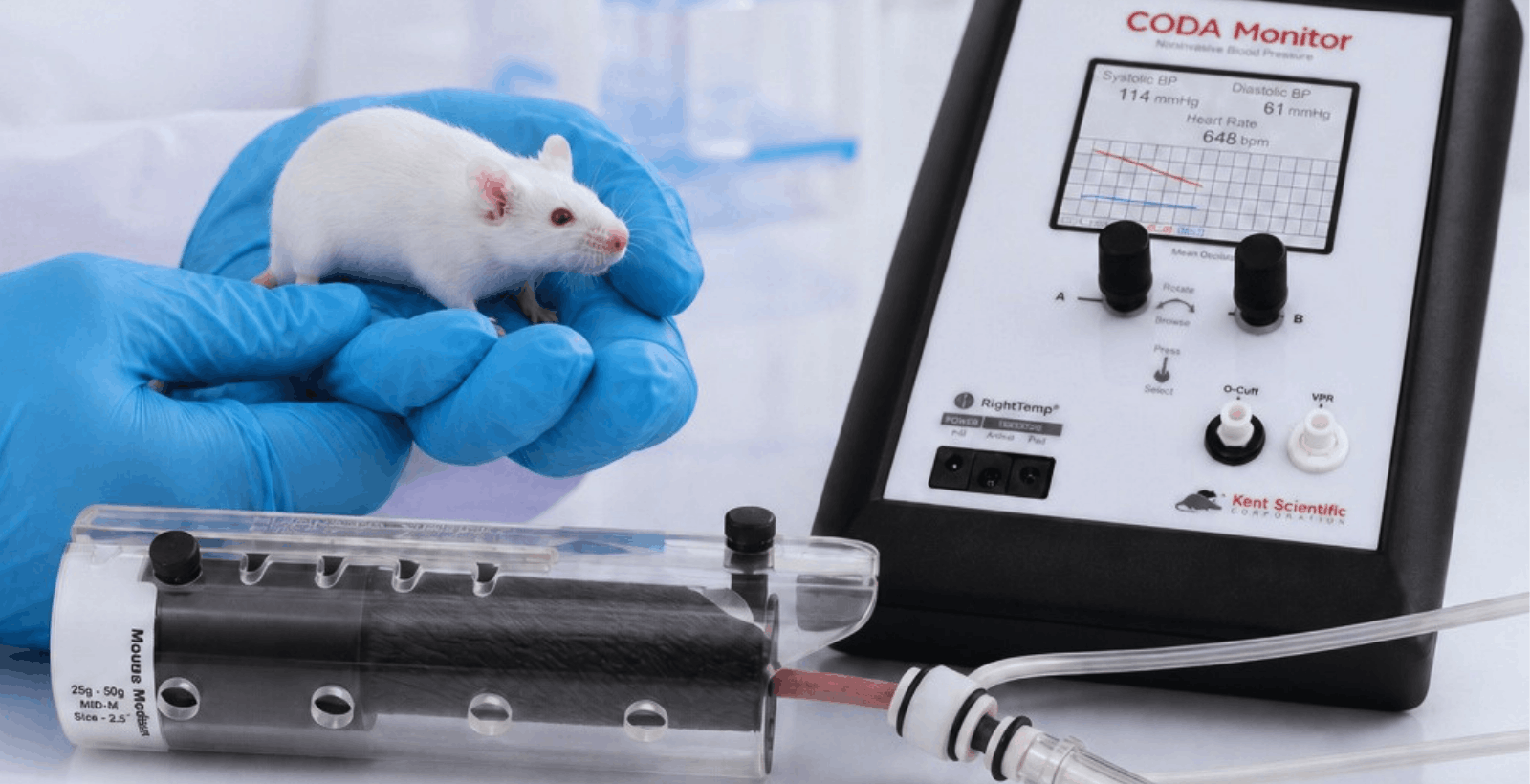
CODA uses Volume Pressure Recording (VPR), which detects changes in tail blood volume, and subsequent pressure changes, as blood returns to the tail after temporarily being occluded. The CODA High Throughput System is available in configurations for two, four, six, or eight animals measured simultaneously; multiple controllers can be “daisy chained” to detect blood pressures in up to 64 animals simultaneously. Kent lists systolic pressure, diastolic pressure, mean blood pressure, heart rate, tail blood flow, and tail blood volume among the reported parameters.
The detection method is more than a line in a specification table. Many competing tail-cuff systems use photoelectric or photoplethysmographic pulse detection. VPR instead follows pressure-volume changes in the tail, allowing CODA to derive additional information from the return of blood volume during the measurement cycle. Kent also states that the system can be used with awake or anesthetized animals and with dark-pigmented mice. Those capabilities should still be evaluated within the laboratory’s own species, strain, endpoint, and protocol.
VPR has also been evaluated against simultaneous radiotelemetry. In a 2008 study of mice, Feng and colleagues analyzed 560 measurement cycles from 26 sessions. VPR measurements averaged 0.25 mmHg lower than telemetry across the data set, with less agreement at systolic pressures below 110 mmHg or above 180 mmHg. The authors concluded that VPR provided accurate measurements across the physiological blood pressure range studied in mice. Read the PubMed abstract.
That validation supports the method under the reported study conditions. It should not be stretched into a universal accuracy promise for every species, strain, operator, protocol, or pressure range. No instrument earns a lifetime exemption from experimental design.
The closest direct alternatives to CODA High Throughput
Hatteras Instruments MC4000
Although the Hatteras MC4000 uses photoplethysmography, it is probably the closest like-for-like comparison based on its published configuration. Hatteras offers four- to eight-channel mouse and rat platforms, computer control, real-time waveform display, and outputs for systolic pressure, diastolic pressure, mean arterial pressure, and pulse rate.
Hatteras states that its system measures systolic and diastolic pressure rather than calculating them. It also highlights a V-notch sensory assembly to stabilize the animal tail, individual channel temperature monitoring, and holders designed to secure untrained animals. These are manufacturer-published features and should be evaluated through protocol documentation, representative data, and a demonstration with the animals the laboratory expects to study.
Where it competes most directly: Laboratories that need simultaneous measurement of as many as eight mice or rats and want a conventional multi-channel tail-cuff workflow.
Visitech Systems BP-2000
The Visitech BP-2000 offers two-, four-, and six-animal configurations for mice and rats, including combined mouse-and-rat systems. Its platform uses photoplethysmography and reports systolic pressure, diastolic pressure, and heart rate while calculating mean blood pressure.
The BP-2000 includes automated temperature control and can be used with conscious or anesthetized animals, according to the manufacturer. Visitech also says the system can be expanded to a maximum of six channels. Its lower maximum simultaneous throughput may or may not matter; for laboratories running smaller cohorts, platform familiarity, existing protocols, or installed equipment may carry more weight than two additional positions.
Where it competes most directly: Laboratories that want an established photoplethysmographic system and need up to six simultaneous readings.
IITC Life Science MRBP
The current IITC MRBP product page describes configurations for one to 24 animals, computer control for multi-channel systems, photoelectric detection, digitally controlled fan warming, and USB connectivity. IITC emphasizes measurement at comparatively low warming temperatures and offers options for MRI-related workflows. Software reports data from an amplifier to report systolic and mean blood pressures as well as heart rate; diastolic blood pressure is automatically computed.
Some distributor pages describe IITC-derived systems that can be daisy-chained to much larger channel counts. For example, Campden Instruments and WPI Europe describe expansion to as many as 200 independently controlled units. Because the current IITC manufacturer page specifies one to 24 animals, laboratories considering a larger installation should confirm the exact supported architecture, control model, footprint, and acquisition workflow directly with the supplier. “Up to 200” is not the same thing as a single compact 200-animal platform.
Where it competes most directly: Laboratories prioritizing modular expansion, photoelectric detection, lower-temperature warming claims, or specialized MRI-compatible options.
Systems that overlap—but are not direct equivalents
Panlab/Harvard Apparatus NIBP
Panlab’s NIBP system uses sphygmomanometry to measure blood pressure, and can be configured for multiple mice or rats, but the workflow is different from simultaneous multi-channel acquisition. Panlab’s own six- and 12-animal configuration description states that animals can be restrained and warmed together, while the system switches between them and measures blood pressure sequentially.
That can still improve workflow compared with preparing one animal at a time, but it should not be represented as equivalent to simultaneous measurement of two to eight animals. Sequential acquisition also means that measurement timing differs across subjects, which may matter for time-sensitive interventions.Importantly, special considerations must be taken for anesthetized animals and during some treatment protocols.
Best fit: Laboratories that value multi-animal habituation and automated sequential measurement more than simultaneous acquisition.
Muromachi MK-2000ST
The Muromachi MK-2000ST is a single-animal system with a broad published range of holders and cuff-pulse sensors. Muromachi lists options extending from neonatal animals weighing 1.4 grams through rats weighing as much as 800 grams, along with a sensor intended for C57BL/6 mice. The system uses an LED and phototransistor for detection and reports systolic and mean blood pressure; its published specification states that diastolic pressure is calculated from systolic and mean pressure.
Muromachi also positions the system for measurement without preheating. That makes it relevant for specialized animal populations or protocols, but it is not a direct high-throughput replacement for an eight-animal system.
Best fit: Laboratories working with neonatal, unusually small,or other specialized animals where sensor and holder range matters more than multi-animal throughput.
Columbus Instruments NIBP
The Columbus Instruments NIBP uses separate occlusion and sensing cuffs and reports systolic pressure, diastolic pressure, mean arterial pressure, and heart rate. Columbus publishes a blood pressure range of 20 to 290 mmHg, a heart-rate range of 1 to 900 beats per minute, and a 26-second reading sequence, including a 10-second pre-reading period and 16-second measurement.
The public product page describes scheduled measurements and calls the system high-capacity, and the user manual suggests a multi-channel option, but the public page does not specify simultaneous multi-animal configurations comparable to CODA High Throughput. Without that information, it is more defensible to classify Columbus as a single-animal or sequential workflow alternative.
Best fit: Laboratories interested in a dual-cuff architecture and scheduled measurements that do not require documented simultaneous multi-animal acquisition.
A defensible side-by-side comparison
The table below summarizes information published by each manufacturer as of August 2026. It is a purchasing screen, not an independent performance ranking.
User manual lists multichannel capability; public page is not specific
Dual-cuff palpation
Systolic, diastolic, MAP, heart rate
Dual-cuff, scheduled measurement workflow
Specifications change. Before purchase, laboratories should request a current quotation, model-specific specification sheet, software requirements, and a protocol demonstration. Channel count is especially easy to misread when “multi-animal,” “multi-channel,” “expandable,” and “simultaneous” are used as if they mean the same thing. They do not.
Where telemetry fits
Implantable radiotelemetry is the appropriate comparison when a study requires continuous blood pressure data in freely moving animals, diurnal patterns, short-lived changes, or detailed hemodynamic time courses. Those capabilities come with surgical implantation, recovery, technical training, and a different cost and throughput model.
Tail-cuff measurement is non-invasive, but it requires restraint or anesthesia and appropriate warming. All can affect the animal’s physiological state. The 2023 Hypertension editorial recommends selecting the method based on the experimental objective and notes that tail-cuff is not appropriate for diurnal fluctuation or immediate blood pressure changes. It also cautions that smaller group differences may be difficult to estimate reliably with non-invasive tail-cuff methods. Review the recommendations.
This is why telemetry should not be presented as an expensive version of CODA—or CODA as a convenient substitute for telemetry. They answer overlapping but different questions.
Seven questions to ask before choosing a system
Do you need scheduled averages or continuous data?
How many animals must be measured at the same time?
Confirm simultaneous acquisition, not simply the number of animals that can be restrained or warmed together.
Which pressure changes must the study resolve?
Small, rapid, or circadian changes may require an invasive method or a different design.
How could species, strain, weight, pigmentation, or other experimental aspects affect measurements?
Both the Jax Mouse Phenome Database (MPD: Mouse Phenome Database: Welcome) and the Medical College of Wisconsin Rat Genome Database (Rat Genome Database ) contain additional information on expected blood pressures with various methods.
What warming and acclimation protocol is required?
Temperature, restraint, habituation, operator technique, and cycle acceptance rules can all affect data quality.
Which values are measured and which are calculated?
Request the method used for systolic, diastolic, and mean pressure rather than relying on the output labels alone.
What will the complete workflow require?
Include holders, cuffs, warming, software, computers, training, replacement parts, calibration or service, data export, and protocol support.
Choose the workflow you can defend
There is no universally best rodent blood pressure system. There is a system that fits the study question, animal population, throughput requirement, and data-quality plan—and several that do not.
CODA High Throughput is a strong fit when a laboratory needs simultaneous, non-invasive measurement in as many as eight mice or rats, wants VPR rather than basic optical pulse detection, or needs tail blood flow and volume alongside standard pressure outputs. Hatteras, Visitech, and IITC deserve direct evaluation when their detection methods, channel architectures, or existing laboratory workflows are a better match. Panlab, Muromachi, Columbus, and telemetry should remain in the conversation when the actual experimental job points in their direction.
Kent Scientific can help laboratories map the measurement method, animal setup, acclimation plan, and throughput to the study design before equipment is selected. Talk with a Kent Scientific specialist about building a consistent, reproducible rodent blood pressure workflow.
Disclaimer
All product specifications in the body and comparison table were checked against current manufacturer product pages linked at the point of claim.
Hatteras and other vendor accuracy or “measured, not calculated” statements are identified as manufacturer claims, not independent findings.
IACUC Protocols for Rodent Research: What to Include and How to Prepare
TL;DR
An IACUC protocol describes proposed animal work so the institution can evaluate it before covered activities begin. A useful rodent protocol connects the research question, animal numbers, procedures, and care in one consistent account. Use your institution’s current form...
RFID Microchips for Mice and Rats: A Guide to Rodent Identification
TL;DR
RFID microchips give research mice and rats an electronic identifier that a compatible reader can retrieve. They are worth considering when the same animal moves through repeated procedures, measurements, or staff handoffs. Their usefulness depends on how reliably the scan...
Laboratory Animal Management: Building Better Rodent Research Workflows
TL;DR
Laboratory animal management connects daily care with the people, procedures, and records that support a study. For mice and rats, the practical goal is continuity: the approved plan should remain clear as an animal moves from housing through a procedure and recovery. Reliable...
Rat as a Model Organism: Advantages, Limitations, and When to Use Rats in Research
TL;DR Why are rats used as model organisms?
Rats are used as model organisms because their physiology, behavior, body size, and well-characterized genetics make them useful for studying complex biological systems and human disease. Compared with mice, their...
Tail-Cuff vs. Telemetry: How to Choose Based on Study Design
TL;DR
Choose tail-cuff when your study needs scheduled blood pressure measurements across multiple mice or rats without surgical implantation. Choose telemetry when continuous, beat-to-beat, circadian, or freely moving measurements are essential to the hypothesis. Neither method is universally better. The right choice...
How to Reduce Waste Anesthetic Gas in Rodent Workflows
TL;DR
To reduce waste anesthetic gas in rodent workflows, start at the source: use an appropriate fresh gas flow for the animal and procedure, connect and maintain an effective scavenging system, check the anesthesia circuit for leaks, limit gas release during induction and...
Guide to Green Anesthesia in Research Labs
Practical ways to reduce waste gas, cost, and environmental impact in rodent workflows
TL;DR
Green anesthesia in research labs is about reducing avoidable waste while still delivering appropriate anesthesia for the animal and procedure. In rodent workflows, that usually starts with flow rate, waste anesthetic gas...
Traditional vs. Integrated Digital: How to choose Anesthetic Vaporizers
Why Size-Appropriate Anesthesia Matters for Animal Safety
TL;DR:
Traditional vaporizers are familiar and widely used, but they are often run at flow rates above what mice and rats need. Integrated digital anesthetic vaporizers are designed to make small animal anesthesia more size-appropriate, with lower...
Research Workflows: What to Consider When Choosing Between Rats and Mice?
TL;DR
Labs choose between rats and mice based on the study question, not convenience alone. Mice often fit genetic or high-throughput work. Rats often fit workflows that need larger body size, easier surgical access, richer behavioral testing, or repeated sampling. The...
Guide to Waste Anesthesia Gas Leakage and Compliance
What your research lab should check before your next anesthesia audit
TL;DR
Waste anesthetic gas problems rarely start with one dramatic failure. They often come from small leaks, worn tubing, loose fittings, saturated scavenging, inconsistent setup, and incomplete documentation. For labs using traditional vaporizers, service...
Building a Preclinical Procedure Station
What labs need for anesthesia, oxygen, monitoring, and surgery
TL;DR
A good preclinical procedure station is built around the procedure, species, endpoint, and user workflow. Start with anesthesia delivery and oxygen strategy, then plan respiratory support, monitoring, surgical tools, warming, recovery, documentation, and training. The goal is a...
Waste Anesthetic Gas’ Impacts on the Environment
How your lab can dramatically improve its carbon footprint
TL;DR
In this article, we dig into waste anesthetic gas’ impact on the environment. If you run mouse anesthesia at 1–1.5 L/min, most of what you deliver isn’t being used by the animal. It’s going to scavenging—or...
Important Note: The content on this blog is general educational material. It is not a protocol, regulatory guidance, veterinary recommendation, clinical directive, or safety instruction for any specific laboratory, study, animal model, institution, species, procedure, or equipment configuration.
Do not apply any information from this blog to your research without first independently confirming that it is appropriate for your specific protocol, species, model, equipment configuration, firmware version, institutional requirements, IACUC or ethical review approvals, safety policies, and applicable regulations. To the extent any content on this blog addresses Kent Scientific or other specific products, it does not replace, modify, or supplement the official User Manual or product labeling for those products.
Kent Scientific assumes no liability for any outcome resulting from reliance on blog content. Every research environment is different, and the suitability of any approach described here for your specific circumstances can only be determined by qualified personnel with knowledge of your particular setup, protocol, and regulatory obligations. Always consult your institutional veterinarian, IACUC, facility leadership, safety officer, and official product documentation before implementing any change to your procedures.
To provide the best experiences, we use technologies like cookies to store and/or access device information. Consenting to these technologies will allow us to process data such as browsing behavior or unique IDs on this site. Not consenting or withdrawing consent, may adversely affect certain features and functions.
Functional
Always active
The technical storage or access is strictly necessary for the legitimate purpose of enabling the use of a specific service explicitly requested by the subscriber or user, or for the sole purpose of carrying out the transmission of a communication over an electronic communications network.
Preferences
The technical storage or access is necessary for the legitimate purpose of storing preferences that are not requested by the subscriber or user.
Statistics
The technical storage or access that is used exclusively for statistical purposes.The technical storage or access that is used exclusively for anonymous statistical purposes. Without a subpoena, voluntary compliance on the part of your Internet Service Provider, or additional records from a third party, information stored or retrieved for this purpose alone cannot usually be used to identify you.
Marketing
The technical storage or access is required to create user profiles to send advertising, or to track the user on a website or across several websites for similar marketing purposes.
To provide the best experiences, we use technologies like cookies to store and/or access device information. Consenting to these technologies will allow us to process data such as browsing behavior or unique IDs on this site. Not consenting or withdrawing consent, may adversely affect certain features and functions.
Functional
Always active
The technical storage or access is strictly necessary for the legitimate purpose of enabling the use of a specific service explicitly requested by the subscriber or user, or for the sole purpose of carrying out the transmission of a communication over an electronic communications network.
Preferences
The technical storage or access is necessary for the legitimate purpose of storing preferences that are not requested by the subscriber or user.
Statistics
The technical storage or access that is used exclusively for statistical purposes.The technical storage or access that is used exclusively for anonymous statistical purposes. Without a subpoena, voluntary compliance on the part of your Internet Service Provider, or additional records from a third party, information stored or retrieved for this purpose alone cannot usually be used to identify you.
Marketing
The technical storage or access is required to create user profiles to send advertising, or to track the user on a website or across several websites for similar marketing purposes.