Traditional vs. Integrated Digital: How to choose Anesthetic Vaporizers
Why Size-Appropriate Anesthesia Matters for Animal Safety
TL;DR:
Traditional vaporizers are familiar and widely used, but they are often run at flow rates above what mice and rats need. Integrated digital anesthetic vaporizers are designed to make small animal anesthesia more size-appropriate, with lower flow, more controlled delivery, and less wasted anesthetic gas. If your lab is running mouse or rat procedures, the key question is whether your anesthesia setup supports stable, repeatable, animal-appropriate delivery when you need it most.
When your anesthesia vaporizer becomes part of your study
Anesthesia is part of the study, even when it is not the endpoint.
If the animal gets too cold, breathes unevenly, recovers poorly, or receives anesthesia through a setup that changes from user to user, the procedure may still appear to go as planned. The data may tell a different story.
That is why your vaporizer choice matters.
For small animal research teams, the decision between a traditional vaporizer and an integrated digital anesthetic vaporizer is a decision about control: how precisely the system delivers anesthetic, how much gas moves through the circuit, how repeatable the workflow is, and how well the setup fits the animal in front of you.
Mice and rats are small. Their anesthesia systems should be built around that reality.
Traditional vaporizers: familiar, durable, and easy to over-flow
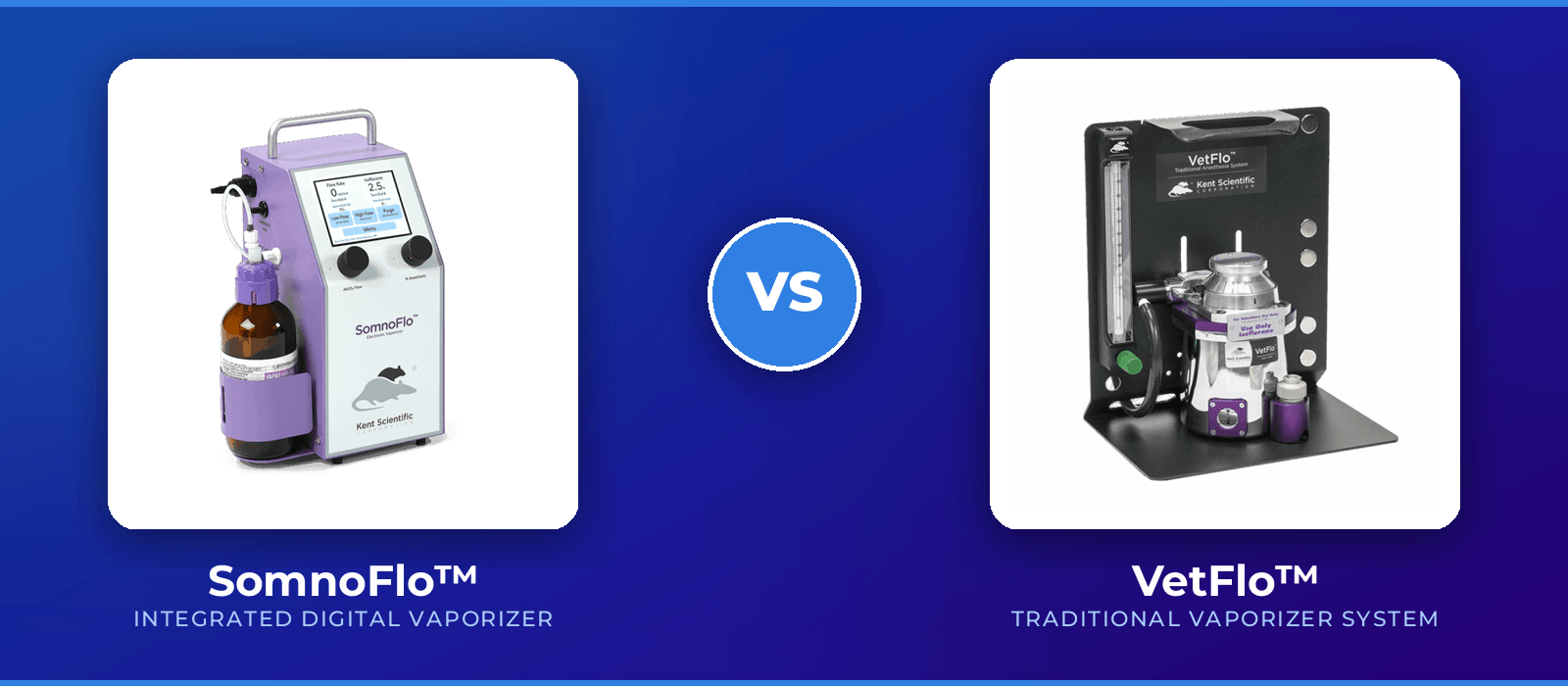
A traditional anesthetic vaporizer is the familiar tabletop device used to vaporize liquid anesthetic, such as isoflurane or sevoflurane, into a carrier gas stream.
These systems are widely used. Many labs know them well. They can be durable, serviceable, and familiar across research and veterinary environments.
The challenge is scale.
Traditional mouse inhalation anesthesia is commonly delivered at flow rates around 1–1.5 L/min or higher. In Kent’s low-flow anesthesia model, that is far above what a mouse ventilates, so much of the delivered anesthetic becomes waste anesthetic gas instead of useful anesthesia delivery. Source: Kent Low-Flow Anesthesia Factsheet
Traditional vaporizers also tend to require more user-managed steps: carrier gas setup, flowmeter adjustment, vaporizer calibration, induction and maintenance transitions, scavenging checks, and system-to-system consistency.
For experienced users, that can be manageable.
For busy labs with rotating users, multiple stations, and long study timelines, every manual variable creates another place for drift.
Integrated digital vaporizers: more control built into the station
An integrated digital anesthetic vaporizer combines vaporization, flow control, and system monitoring into a more unified anesthesia platform.
Instead of asking the user to manage every element separately, an integrated system is designed around a controlled workflow. The goal is to make anesthesia delivery more consistent, more size-appropriate, and easier to reproduce across users.
For small animal research, that matters because the animal’s size changes the scale of everything.
A mouse needs a smaller, more controlled anesthesia workflow than a larger animal. A rat needs a station that can support stable delivery without pushing unnecessary gas through the circuit. Small animal anesthesia works best when the system is scaled to the animal and the procedure.
The value of digital control is practical: better control, better repeatability, and a workflow that is easier to teach and defend.
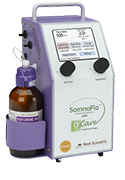
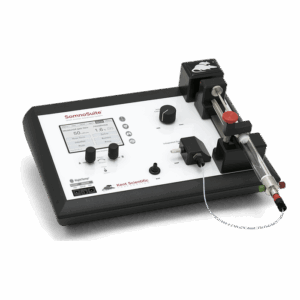
Kent’s SomnoSuite® is a low-flow anesthesia delivery system designed specifically for mice and rats. Kent’s SomnoFlo® and SomnoFlo O2Care® are low-flow electronic vaporizer options designed for small animal anesthesia workflows.
Why “small animal” anesthesia should actually be small
Small animals lose heat quickly.
They have limited respiratory reserve.
They are more vulnerable to changes in temperature, ventilation, oxygen strategy, and anesthetic depth.
A good anesthesia setup should help the team avoid unnecessary instability.
Size-appropriate anesthesia starts with a simple question:
Is the system scaled to the animal and procedure?
In rodent anesthesia, that usually comes down to a few practical controls:
- flow rate
- anesthetic concentration
- carrier gas strategy
- warming support
- scavenging
- recovery monitoring
- user consistency
A traditional vaporizer can be part of a careful workflow. It also leaves more of these variables in the hands of the user.
An integrated digital system can reduce that burden by building more control into the station itself.
Mice and rats do not need excess carrier gas to stay anesthetized
Excess carrier gas does not automatically create better anesthesia.
In a representative low-flow comparison, Kent modeled the same 2% isoflurane concentration delivered at 0.1 L/min versus 1.5 L/min. The intended anesthetic concentration stays the same. The flow rate changes the amount of gas moving through the system. Source: Kent Low-Flow Anesthesia Factsheet
That distinction matters.
Low-flow delivery should be understood as controlled delivery at a lower carrier gas volume, with the intended anesthetic concentration preserved.
Small physiologic changes can become study variables
Small animals can become unstable quickly under anesthesia, especially when temperature, respiratory pattern, oxygen strategy, or anesthetic depth drift during a procedure.
That instability can affect welfare and data quality.
Your anesthesia station cannot remove every source of variability, but it can help reduce avoidable variation by making delivery more consistent across users and procedures.
Stable depth depends on more than the dial setting
The first job of any anesthesia system is appropriate anesthetic depth.
Researchers need animals deep enough for the procedure, stable enough to protect welfare, and able to recover as expected. Too light creates movement, stress, and procedural risk. Too deep can depress respiration and slow recovery.
Traditional vaporizers can deliver the same agent concentration as digital systems, but the surrounding workflow may be less controlled. Flow, timing, induction habits, and maintenance settings can vary between users.
Integrated digital vaporizers help standardize those variables. In systems designed for small animals, users can work with lower, more appropriate flow while maintaining the intended anesthetic concentration.
Concentration matters, but so do flow, timing, and user consistency
The vaporizer dial is only one part of the anesthesia workflow.
Procedure length, induction habits, maintenance flow, scavenging setup, oxygen strategy, warming, and recovery monitoring all influence how stable the procedure feels for the animal and how repeatable it is for the team.
That is where integrated digital systems can help. They make more of the workflow visible, repeatable, and easier to teach.
Lower flow should preserve intended anesthetic concentration
Low-flow should never mean “guess lower and hope it works.”
In Kent’s representative model, both systems maintain the same 2% isoflurane concentration. The low-flow system runs at 0.1 L/min, while the traditional comparison runs at 1.5 L/min. Source: Kent Low-Flow Anesthesia Factsheet
Same intended concentration.
Less excess flow.
That is the animal safety argument.
The problem with excess flow
Excess flow hides in plain sight because your system still works.
The animal becomes anesthetized. The procedure happens. The team moves on.
But unused gas does not disappear. It moves through the circuit, into scavenging, or into the room if there are leaks, poor seals, or inconsistent transitions.
More gas through the circuit means more waste
Kent’s low-flow model shows why flow matters so much.
Using representative mouse anesthesia settings, lowering flow from 1.5 L/min to 0.1 L/min creates a 15× reduction in flow while maintaining the same 2% isoflurane concentration. Source: Kent Low-Flow Anesthesia Factsheet
That lower flow reduces anesthetic agent use, oxygen use, waste anesthetic gas burden, and modeled CO₂ equivalency impact.
Waste anesthetic gas starts with the setup
Every anesthesia station needs appropriate scavenging. Lower flow does not replace scavenging, leak checks, or good technique.
It does reduce the amount of gas the workflow has to manage.
That matters in real rooms, with real users, under real time pressure.
Staff exposure is a workflow issue
Waste anesthetic gas exposure rarely comes from one dramatic failure. It usually comes from the ordinary parts of the workflow: a loose connection, a rushed induction transition, a scavenging canister that needs attention, or a flow setting that is higher than the animal needs.
A lower-flow setup reduces the volume moving through the system before those problems begin.
Scavenging still matters
Scavenging remains essential with any inhalation anesthesia system.
Lower flow simply gives the scavenging setup less gas to handle. It reduces burden at the source, then good scavenging and leak checks manage the remainder.
Lower flow reduces the burden before scavenging begins
The safest workflow is the one that reduces avoidable gas volume and still uses appropriate controls.
Good technique still matters. Low-flow supports it.
Environmental impact starts at the flowmeter
Volatile anesthetic agents are greenhouse gases. Published reviews of anesthesia-related emissions describe inhaled anesthetics such as isoflurane, sevoflurane, desflurane, and nitrous oxide as gases with global warming potential. See: Global warming potential of inhaled anesthetics and Anesthesia and its environmental impact.
For many labs, environmental impact has become a real facilities conversation. Sustainability teams, procurement groups, and institutional leadership are paying more attention to procedure rooms, gas use, and waste anesthetic emissions.
Rodent anesthesia is a practical place to look because flow is controllable.
Volatile anesthetics do not disappear after the procedure
When volatile anesthetics are released, they contribute to environmental impact. That does not mean every lab has the same footprint or the same reduction options.
It does mean gas use should be visible and intentional.
A system that uses less carrier gas while preserving intended anesthetic concentration can reduce waste gas volume and help lower modeled environmental impact.
Lower flow gives labs a practical reduction lever
In Kent’s representative low-flow model, lowering flow from 1.5 L/min to 0.1 L/min reduces waste volume dramatically while maintaining the same 2% isoflurane concentration. The model also shows lower emissions (measured as CO₂e) per hour under those settings. Source: Kent Low-Flow Anesthesia Factsheet
For a lab trying to reduce environmental impact without disrupting the protocol, flow rate is a practical place to start.
The purchase price is only the first cost
Traditional vaporizers often look less expensive at purchase. Over time, the station has recurring costs: isoflurane, oxygen, calibration, scavenging supplies, and downtime.
That is where the comparison changes.
In our representative low-flow example, one bottle of isoflurane lasts 412 hours at low flow versus 27 hours traditionally. A 10L oxygen tank lasts 908 hours in the low-flow example versus 22 hours in the traditional example.
Actual savings vary by supplier, region, usage, and local workflow. The relationship is still useful: the more gas the station uses, the more the operating cost matters.
Isoflurane, oxygen, calibration, and downtime add up
Anesthesia systems behave like capital equipment at purchase and like operating cost centers over time.
The real cost includes:
- anesthetic agent
- oxygen or carrier gas
- scavenging supplies
- service and calibration
- procedure interruptions
- retraining when workflows drift
For labs that use anesthesia occasionally, payback may be slower. For labs running frequent mouse and rat anesthesia, multiple stations, or longer procedures, operating cost becomes a bigger part of the decision.
The more often you run anesthesia, the more flow matters
Flow matters because it scales with use.
One hour a week is one kind of cost picture. Ten hours a week across multiple stations is another.
Before choosing a system, estimate weekly anesthesia hours, typical flow settings, agent cost, oxygen cost, and service requirements. Those numbers often make the decision clearer than purchase price alone.
How to compare traditional and integrated digital vaporizers
A useful comparison starts with the workflow, then moves to the equipment.
Ask what the lab needs the anesthesia station to protect: stable depth, animal welfare, user consistency, staff safety, environmental goals, operating cost, or all of the above.
When a traditional vaporizer can still make sense
A traditional vaporizer may be a good fit when the lab has experienced users, stable SOPs, lower procedure volume, and a strong maintenance process already in place.
Traditional systems can be familiar and serviceable. They may also fit labs where existing workflows are well controlled and environmental or consumable costs are not major decision drivers.
When integrated digital control is worth a closer look
An integrated digital vaporizer may be a better fit when the lab needs tighter workflow control, lower flow, less user-to-user variation, better support for small animal-specific procedures, and clearer documentation across users or sites.
The practical difference shows up in how much control the system gives the user, and how much consistency the station helps protect.
Where integrated digital vaporizers help most
Integrated digital systems tend to make the most sense when the procedure leaves little room for drift.
That includes longer anesthesia windows, stereotaxic procedures, imaging workflows, catheter placement, surgical models, physiology studies, and other work where stable depth, oxygen strategy, and temperature support matter.
They are also useful when many users touch the same station.
A PI may know exactly how the setup should run. A senior technician may have the muscle memory. But graduate students, postdocs, and new staff still need a system that helps them run the workflow consistently.
Good equipment does not replace training.
It makes training easier to follow.
Longer procedures
Longer procedures give small inconsistencies more time to matter.
When animals stay under anesthesia for longer windows, the station needs to support stable delivery, warming, oxygen strategy, and repeatable recovery planning.
Stereotaxic and imaging workflows
Stereotaxic and imaging procedures often need stable access, minimal disruption, and predictable anesthesia over time.
A low-flow digital system can help reduce excess gas movement while supporting a more controlled station setup.
Multi-user labs with rotating students or staff
Multi-user labs need equipment that helps protect the SOP.
Integrated digital systems can make training easier because fewer critical variables depend on memory, habit, or “the way one person does it.”
Where SomnoSuite and SomnoFlo fit
Kent’s integrated anesthesia systems are designed around small animal workflows.
The product choice depends on your procedure, species, number of animals, gas source, oxygen needs, and how your team wants the station to function.
SomnoSuite: low-flow delivery for mouse and rat workflows
SomnoSuite is a low-flow anesthesia delivery system built specifically for mice and rats. It combines a precision syringe pump with digital vaporizer control, helping teams deliver controlled anesthesia at low flow rates appropriate for small animal use.
SomnoSuite is often a strong fit for labs that want precise low-flow delivery for mouse and rat anesthesia workflows, especially when small-animal scale and repeatability are priorities.
SomnoFlo and SomnoFlo O₂ Care: low-flow vaporization with oxygen strategy options
SomnoFlo is a low-flow electronic vaporizer designed for small animal anesthesia workflows.
SomnoFlo O₂ Care adds oxygen control for labs that want low-flow delivery with a more deliberate oxygen strategy. Kent’s product page states that SomnoFlo O₂ Care can adjust carrier gas composition to 21%, 35%, 50%, 70%, or 100% oxygen and run ultra-low flow rates as low as 100 mL/min.
For some labs, the priority is precise low-flow delivery for very small animals.
For others, the priority is oxygen strategy, longer procedure time, or lowering waste anesthetic gas burden.
The right system is the one that fits the study and makes the workflow easier to repeat.
Questions to ask before choosing your vaporizer
Before comparing vaporizer prices, ask a few workflow questions:
- How often are mice or rats under anesthesia each week?
- How long are typical procedures?
- How many users run the station?
- Do you need oxygen blending or a defined oxygen strategy?
- Are you running one animal, multiple animals, or stereotaxic workflows?
- How much does setup vary between users?
- How often are vaporizers serviced or calibrated?
- Are waste anesthetic gas exposure and environmental impact part of your facility’s goals?
Those answers will usually show whether the decision is driven mostly by purchase price, operating cost, or total workflow control.
A better anesthesia station helps protect the animal and the data
The best anesthesia setup is the one your team can run consistently.
That sounds simple, but it is the part that protects animal welfare and data quality. Stable depth, lower waste, controlled flow, appropriate oxygen strategy, warming support, and repeatable setup all make the procedure easier to defend.
Traditional vaporizers still have a place.
Integrated digital vaporizers give small animal research teams another option: a station built around the size of the animal and the realities of modern research workflows.
If your lab is trying to reduce waste, improve repeatability, support animal safety, or better understand the total cost of rodent anesthesia, vaporizer choice is a good place to start.
FAQ: Traditional vs. integrated digital anesthetic vaporizers
What is the difference between a traditional vaporizer and an integrated digital anesthetic vaporizer?
A traditional vaporizer vaporizes liquid anesthetic into a carrier gas stream via a series of wicks and baffles, and usually relies on separate flow control, gas source, scavenging, and user-managed setup. An integrated digital anesthetic vaporizer combines more of the anesthesia delivery workflow into one controlled platform, often with digital flow control and small animal-specific settings.
Why does flow rate matter in mouse and rat anesthesia?
Flow rate controls how much carrier gas and anesthetic volume moves through the system. If flow is much higher than the animal can use, more anesthetic becomes waste gas. In Kent’s representative mouse anesthesia model, lowering flow from 1.5 L/min to 0.1 L/min maintains the same 2% isoflurane concentration while reducing waste volume.
Does low-flow anesthesia mean less anesthetic depth?
No; low-flow preserves the intended anesthetic concentration. In Kent’s representative comparison, both systems deliver 2% isoflurane. The difference is carrier gas flow, not intended concentration. Each lab should verify what is appropriate for its protocol, animal model, equipment, and institutional requirements.
Are integrated digital vaporizers safer for animals?
Integrated digital vaporizers can support animal safety by helping teams run a more controlled, repeatable, size-appropriate anesthesia workflow. Animal safety still depends on the full protocol, including anesthetic depth, warming, monitoring, oxygen strategy, scavenging, recovery support, training, and institutional requirements.
Why do traditional vaporizers create more waste anesthetic gas?
Traditional vaporizers are often used at higher flow rates than small animals need. Higher flow moves more anesthetic through the circuit. Gas that is not taken up by the animal must be scavenged or may contribute to room exposure if the setup has leaks or poor transitions.
How does vaporizer choice affect environmental impact?
Volatile anesthetics such as isoflurane and sevoflurane have global warming potential when released. Lower-flow systems reduce the volume of anesthetic gas moving through the circuit, which can reduce modeled emissions when the intended anesthetic concentration is maintained. See: Global warming potential of inhaled anesthetics and Anesthesia and its environmental impact.
When should a lab consider SomnoSuite?
SomnoSuite may be a good fit when the lab needs low-flow anesthesia delivery specifically designed for mouse and rat workflows, especially where small-animal scale, repeatability, and controlled delivery are priorities. Product details: SomnoSuite.
When should a lab consider SomnoFlo or SomnoFlo O2 Care?
SomnoFlo may be a good fit when the lab wants a low-flow electronic vaporizer for small animal anesthesia. SomnoFlo O₂ Care may be a better fit when the lab also wants defined oxygen composition options and ultra-low flow delivery. Product details: SomnoFlo and SomnoFlo O2Care.
Helpful next step
If you are comparing traditional and integrated digital anesthetic vaporizers, Kent can help you map the decision to your workflow.
Start with species, procedure length, number of users, oxygen needs, and weekly anesthesia hours. From there, we can help you compare the setup that fits your protocol, protects animal welfare, and keeps your workflow repeatable.
Talk to Kent about your anesthesia workflow: Contact Kent
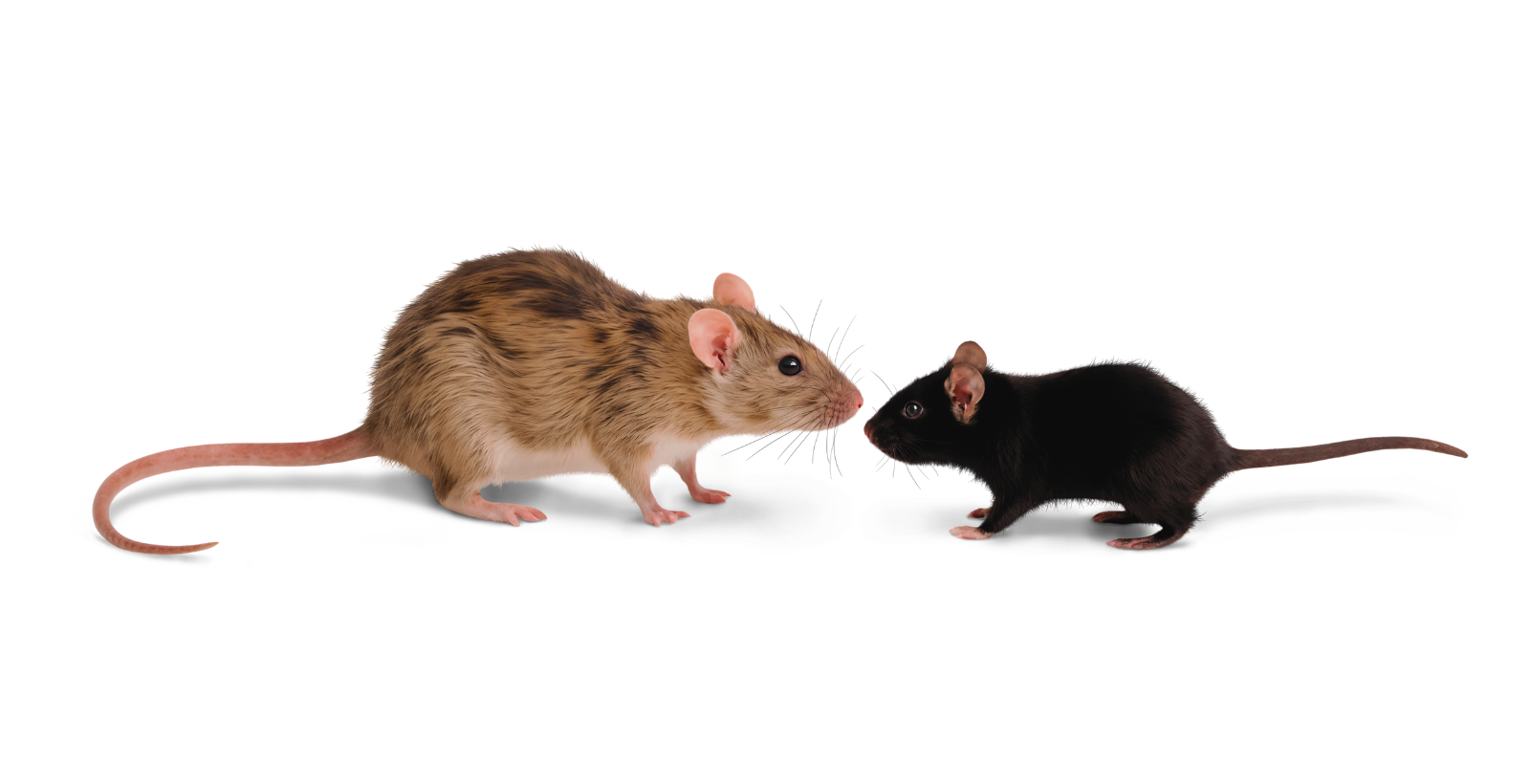
Deciding between rats or mice for your research? Learn more here