


















The Monument to the Laboratory Mouse: the Real MVP of Biomedical Research
There are statues for generals, poets, and the occasional guy on a horse who definitely did some questionable things.
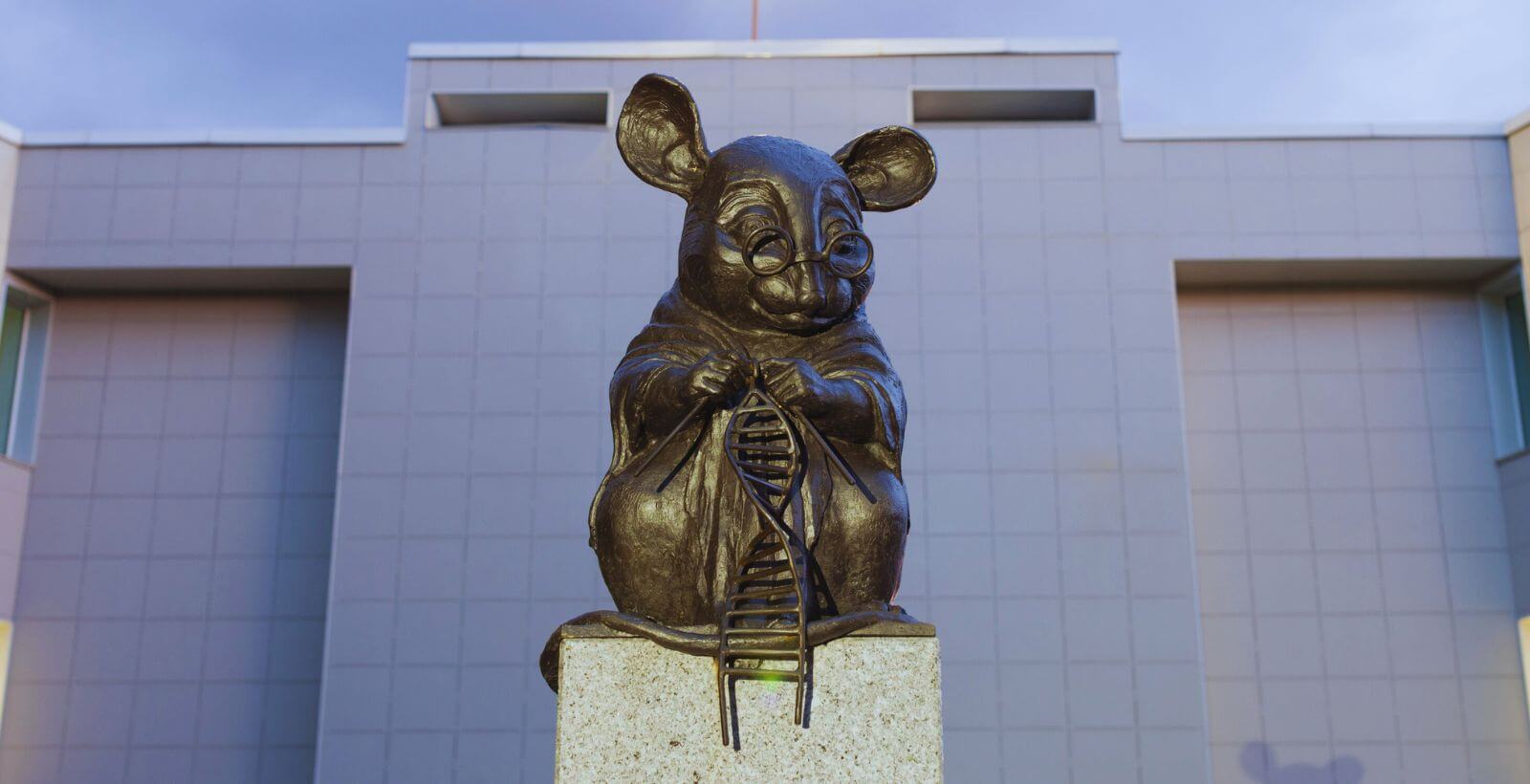
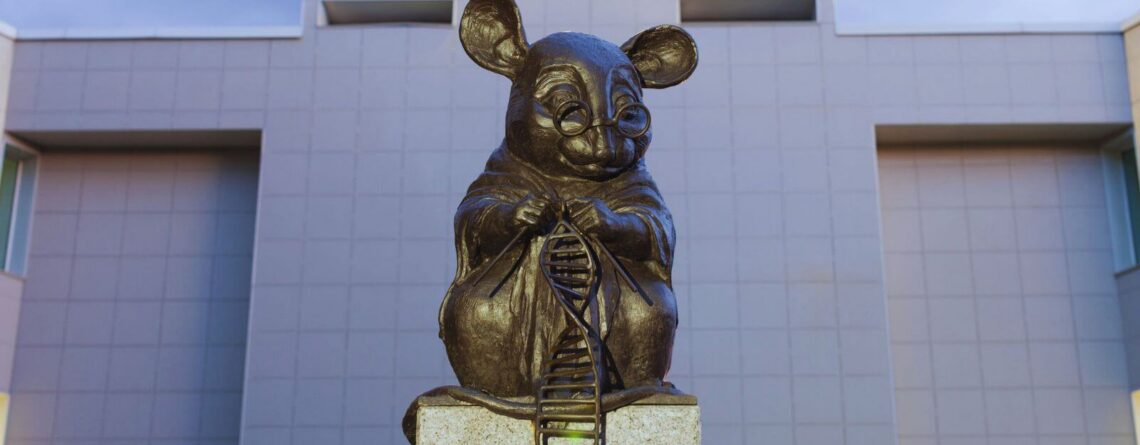
And then there’s this: a 70-cm bronze laboratory mouse in Novosibirsk, Siberia, perched on a granite pedestal, wearing pince-nez glasses… calmly knitting a DNA double helix like it has grant deadlines and reviewers to satisfy.
It’s called the Monument to the Laboratory Mouse, and it sits outside the Institute of Cytology and Genetics in Akademgorodok (Novosibirsk).
This isn’t kitsch.
It’s a public thank-you note.
A weirdly charming one.
And if you work in preclinical research, it lands a little harder than it should.
What the monument is actually saying
The simplest reading is gratitude: the mouse is honored because of its role in helping scientists understand disease mechanisms and develop therapies.
But the sculpture is clever about how it says that.
The mouse isn’t depicted as a victim. It’s depicted as a collaborator—small, focused, and in the middle of work. The artist explicitly mentioned combin[ing] both the image of a laboratory mouse and a scientist” to serve “one cause.”
That’s a provocative idea: not that we’re the heroes and the animals are props, but that discovery is a shared enterprise—one with moral weight, whether we prefer to talk about it or not.
The details of the Monument to the Laboratory Mouse are the point
Atlas Obscura nails the vibe of this anthropomorphic, “wise-looking” mouse:
“…with glasses… dressed in a lab coat, and studiously knitting a DNA double helix.”
Even the helix direction is symbolic. In popular retellings of the Monument to the Laboratory Mouse, the helix is described as left-handed, a nod to Z-DNA—less common, more complex, and still full of unanswered questions. The “knitting” metaphor isn’t just about genetics, it’s about incremental progress: one loop at a time, one experiment at a time, one careful day in the animal room at a time.
Why the Monument to the Laboratory Mouse hits scientists differently
Because it’s not a victory lap. It’s a reminder.
Most of us in the life sciences carry two truths at once:
- animal models have enabled breakthroughs that changed medicine
- the cost—ethical and practical—is real, and it’s paid in living bodies
My Modern Met frames it as a moment to recognize achievements and acknowledge the animals “sacrificed in the name of science… [to] take the time to say thank you to the millions of animals…”
That’s the emotional layer. The scientific layer is simpler: if you’re going to use animals, you owe them—and your data—competence.
Which brings us to the part nobody puts on the postcard.
Why this matters to Kent Scientific
Kent Scientific exists in the space between two realities that every serious scientist knows: animal models have enabled breakthroughs that changed medicine, and the responsibility that comes with that is real.
The Monument to the Laboratory Mouse is a public thank-you note.
For us, it’s also a reminder that gratitude isn’t a feeling—it’s the standard.
That’s why the 3Rs matter so much to us.
Not as a checkbox, but as a practical framework for better science.
- Replacement keeps you honest about whether an animal is truly necessary for the question you’re asking. When non-animal methods can answer the question, they should.
- Reduction isn’t “use fewer animals at any cost.” It’s designing studies and workflows that reduce avoidable variability so you don’t need extra animals to compensate for noise.
- Refinement is where the day-to-day work lives: fewer stressors, better support, cleaner procedures, and better recovery. Refinement is humane and improves data quality.
This connects directly to our three brand pillars: better workflows, better welfare, better data. We don’t see these as separate goals. In animal research, they’re linked.
Better workflows reduce unnecessary handling, shorten procedure time, and make setups consistent across people and across days.
Better welfare reduces stress and physiological instability that can quietly reshape outcomes.
Better data come from stable baselines—temperature, oxygenation, ventilation, monitoring, recovery conditions—so the biology you’re measuring isn’t competing with preventable noise.
The scientific community doesn’t need more speeches about ethics. It needs more repeatable, practical systems that make the right thing easier to do consistently. That’s what we’re trying to contribute: scientific tools and workflows that support refinement in the real world, reduce avoidable variation, and help labs get answers they can trust—without asking animals to pay an unnecessary price for sloppy variables.
If the knitting mouse is a symbol of discovery, the 3Rs are the discipline behind it. And in our view, that discipline is what makes the science worth defending.
Our “Care of Science” takeaway: gratitude is a workflow
A monument is symbolic. A protocol is real.
If you want to honor the animal contribution in a way that actually counts, it shows up in three places:
1) Better welfare isn’t just ethics. It’s variance control.
Stress and poor physiological support don’t just affect animals—they affect outcomes. When your physiology is unstable, your data becomes a confounded mess and you start “fixing” it with bigger n’s and looser interpretation. That’s not rigor. That’s coping.
2) Better workflows reduce handling, reduce drift, reduce rework
Every time a workflow is clunky, animals get handled more, procedures take longer, and stability goes down. Good workflows are calm workflows.
3) Better data starts with basic physiological stability
Temperature, oxygenation, ventilation, recovery conditions—these are not “nice-to-haves.” They are prerequisites for repeatability. If your baseline is unstable, the rest is storytelling.
A final note from the knitting mouse
The Smithsonian piece points out the relationship between humans and mice is sometimes “maligned.”
The Monument to the Laboratory Mouse doesn’t dodge that. It doesn’t argue. It just sits there—patiently knitting a helix—reminding us what good science actually requires: respect, restraint, rigor, and the humility to admit there’s still work to do.
Which is… honestly a pretty good lab standard.
If you’re interested in products that were designed with the 3Rs in mind, check out…Kent Scientific products designed with 3Rs in mind
- SomnoFlo® — rodent anesthesia system that supports Refinement by delivering more consistent inhalant anesthesia and smoother recoveries, reducing physiologic stress that can add noise to your data.
- SomnoFlo® O2Care — oxygen blending / carrier-gas anesthesia system that supports Refinement by enabling more physiologically relevant oxygen delivery (not automatically 100% O₂), improving welfare and study translatability.
- RightTemp® / RightTemp® Jr. — rodent warming and temperature control platforms that support Refinement + Reduction by preventing hypothermia and reducing variability that can force larger n’s.
- PhysioSuite® — small animal physiological monitoring system that supports Refinement by helping teams maintain stable intraoperative conditions via consistently monitoring key vitals.
- CODA® Non-Invasive Blood Pressure System — mouse and rat non-invasive blood pressure monitor that supports Refinement (of invasive methods) by measuring BP without surgical implantation, and Reduction by enabling repeatable cohort data collection, allowing fewer animals to be used over the course of a study.
Further reading
These are the supporting references for this article:
- Stock photo by Dmitry Nikolaev | Dreamstime
- Wikipedia. Monument to the laboratory mouse: https://en.wikipedia.org/wiki/Monument_to_the_laboratory_mouse
- Atlas Obscura. Monument to the Laboratory Mouse in Novosibirsk, Siberia: https://www.atlasobscura.com/places/monument-to-the-laboratory-mouse
- My Modern Met. There’s a Bronze Statue of a Mouse Knitting a DNA Double Helix in Russia: https://www.atlasobscura.com/places/monument-to-the-laboratory-mouse
- Smithsonian Magazine. This Russian Monument Honors the Humble Lab Mouse: https://www.smithsonianmag.com/smart-news/russian-statue-honoring-laboratory-mice-gains-renewed-popularity-180964570/